Fire and Smoke Damage Restoration: The First 48 Hours
The fire is out and the engines have gone, and the house is standing open, soaked, and covered in soot. The two things that matter in the next 48 hours are securing the building and getting soot off surfaces before it bonds to them. Almost everything else can wait a few days. Those two cannot.
Why soot is on a clock
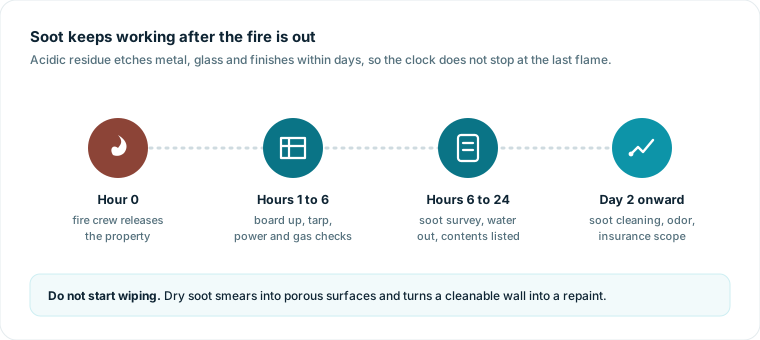
This is the part nobody expects. Smoke residue is acidic, and it keeps reacting with whatever it has settled on long after the flames are gone.
The rough sequence: within hours, discoloration starts on plastics and finishes. Within a day or two, bare metal begins to corrode and grout and porous surfaces start absorbing residue. Within a week, etched glass, pitted chrome, and permanently yellowed appliances and countertops. Fabric and carpet that could have been cleaned on day two may be a write off by day ten.
So the job is not only cleanup. It is beating a chemical clock, and it is the main reason fire and smoke damage restoration crews start before the insurance scope is finalized.
Hours 1 to 6: close the building
A fire leaves holes: broken windows, a ventilated roof, a forced door. Until those are closed, the building is exposed to weather, animals, and anyone walking past, and your insurer expects you to prevent further damage rather than wait.
Emergency board up covers the openings with plywood and fasteners, and roof damage gets tarped or shrink wrapped. This is the same first move as any storm loss, described in the board up guide.
Two safety items belong here too. Do not turn the power or gas back on yourself. Both need checking before anything is re-energized, because fire damages wiring inside walls where you cannot see it. And a house that has had a structural fire may need an inspection before anyone stays in it.
Hours 6 to 24: water, soot survey, contents
Almost every fire is also a water loss. Suppression puts hundreds or thousands of gallons into a building, and that water behaves exactly like any other water loss, which means extraction and structural drying on the normal 3 to 5 day timeline. Left alone it becomes a mold job on top of a fire job.
Meanwhile a technician surveys how far the smoke travelled, which is almost always further than the fire did. Smoke follows air, so it reaches closets, drawers, adjacent rooms, and the HVAC system in houses where the fire stayed in one corner.
Contents get inventoried and sorted: cleanable on site, needs off site contents restoration, or a total loss for the claim. Photograph everything yourself before this starts.
Not all smoke is the same
The residue type decides the cleaning method, and using the wrong method drives the stain into the surface instead of lifting it away.
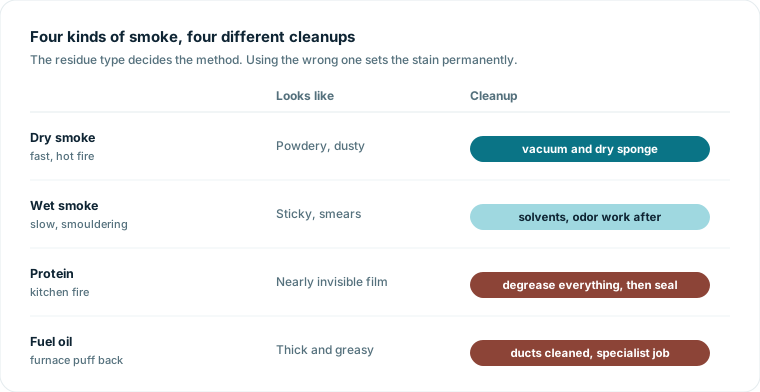
Protein residue is the one that fools people most. A grease fire on a stovetop can leave a kitchen looking almost normal while every surface in the house carries a film and a smell that will not quit. It is also the hardest to deodorize, because a thin film reaches every room rather than concentrating in the one where the fire started.
What not to do
Well-meant cleanup in the first day causes a real share of permanent damage:
- Do not wipe dry soot. It smears into porous surfaces and turns a cleanable wall into a repaint. Dry soot gets vacuumed or dry sponged first.
- Do not run the HVAC. It distributes soot into every room the fire never reached, including the ducts.
- Do not use a household vacuum on soot. Without HEPA filtration it blows fine particles back into the air.
- Do not wash soot-covered clothing in your machine. Residue sets with heat and contaminates the drum.
- Do not plug in or switch on anything that was exposed until it has been checked.
Odor is a separate project
Getting the soot off does not remove the smell, because smoke particles have already lodged in porous material. Real deodorizing is its own phase: cleaning the source material, then treatments like thermal fogging, hydroxyl or ozone generators, and sealing surfaces that cannot be fully cleaned. Ductwork usually needs cleaning as well.
Be skeptical of anyone who deodorizes before the cleaning is finished. Masking a smell on dirty surfaces lasts until the first warm week.
What insurance covers
Fire is a covered peril on essentially every homeowners policy, including the water damage from putting it out and the smoke damage in rooms that never burned. What usually applies:
- Dwelling coverage for the structure, and contents coverage for belongings.
- Additional living expenses for somewhere to stay while the house is uninhabitable. Keep every receipt.
- Emergency mitigation, including board up and tarping, is normally covered and expected rather than optional.
Two things to do early: ask your adjuster to confirm your ALE limit in writing, and start your own contents list immediately rather than relying on memory weeks later. Photos of every room, including inside closets and drawers, are worth more than any list you write afterward.
How long the whole thing takes
Mitigation, meaning board up, water removal, drying, and soot cleaning, usually runs one to three weeks depending on size. The rebuild is a separate construction project and can run one to six months for a significant structural fire. The same two phase split applies as in any mitigation versus restoration job, just on a longer scale.
Quick answers
Can smoke damage be cleaned, or does everything get replaced? Most hard surfaces and many contents clean up well when work starts quickly. Heavily charred material, saturated insulation, and some porous contents are replaced.
Does smoke damage in rooms that did not burn get covered? Yes, smoke and soot damage is part of the fire claim.
Is the smell permanent? Rarely, if the cleaning is done properly and the source material is addressed. Smell that keeps returning means something porous was left in place.
What about a small kitchen fire? Still worth a professional look. Protein residue spreads much further than the visible damage suggests.
If it happened today
Secure the building, keep the power off until it is checked, photograph everything, and do not start wiping. Local crews cover fire and smoke restoration across Stockton, Modesto, Lodi, Manteca, Turlock and the rest of the 209, and dispatch answers 24/7.