How Long Does Water Damage Restoration Take?
Two numbers answer this, and conflating them is why people feel misled. Mitigation, the emergency part, is usually 3 to 5 days. Repairs are a separate 1 to 6 weeks. When a crew says “about four days,” they mean the first number. When your neighbor says their kitchen took two months, they mean both.
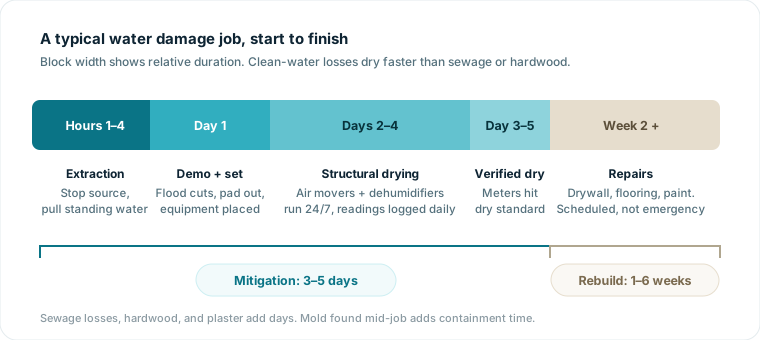
Hours 1 to 4: emergency response
The clock that matters most. A crew stops the source if it is still running, extracts standing water with truck-mounted equipment, and maps how far the moisture actually traveled with meters and thermal imaging.
This phase is fast and it is the one with the most leverage. Water removed in hour two never becomes the mold job in week three. If you are reading this with water on the floor right now, the first hour checklist is the more useful page.
Day 1: demolition and equipment set
Anything that cannot be dried in place comes out. Usually that means carpet pad, soaked insulation, and a flood cut, the bottom foot or two of drywall, so the wall cavity can breathe and dry.
Then the equipment goes in: air movers pointed along wet surfaces to push evaporation, and dehumidifiers to pull that evaporated water out of the air. That pairing is the whole science of it. Air movers without dehumidification just move humid air around.
Days 2 to 4: structural drying
This is the part that feels like nothing is happening, and it is the part you cannot rush. The equipment runs 24 hours a day, and a technician returns daily to take moisture readings and log them. Readings are how anyone knows whether drying is actually working, and they are what your adjuster wants to see.
Two things people ask constantly here:
- Can I turn the equipment off? It is loud. Please do not. Drying stops when the machines stop, and a night of silence can add a day to the job. If noise is unbearable, ask the crew about placement rather than switching things off.
- It looks dry. Why are they still here? Because surfaces dry long before cavities do. The meter reading, not appearance, is what ends this phase.
Day 3 to 5: verified dry
Drying ends when materials hit a documented dry standard, compared against unaffected areas of the same house. Equipment comes out, and the mitigation phase closes with a set of logs that support the claim.
If mold turned up during drying, containment gets added here and the timeline stretches. Mold is the most common reason a “four-day job” becomes a ten-day one.
Week 2 onward: repairs
Now you are in construction, not emergency response: drywall, texture, paint, flooring, trim, cabinets. This runs 1 to 6 weeks depending on scope, and it moves at the speed of scheduling, materials, and insurance approval rather than at the speed of urgency.
A kitchen with custom cabinets and a flooring backorder can sit for a month. A single bedroom with carpet can be back to normal in a week.
What makes drying take longer
Same volume of water, wildly different timelines, depending on what it soaked into.
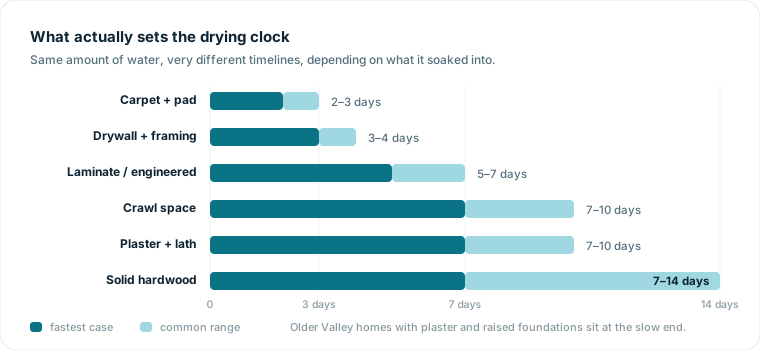
The pattern is density and permeability. Water leaves open, porous assemblies quickly and leaves dense ones slowly.
- Hardwood is the classic timeline killer. It cups, it holds moisture in the tongue and groove, and it often needs specialty mat systems to dry from below.
- Plaster and lath, common in older Lodi and central Stockton homes, holds water far longer than drywall.
- Crawl spaces across the Valley dry slowly because the ground underneath keeps giving moisture back, especially near the Delta.
- Sewage losses add demolition and disinfection before drying even starts.
- Concrete and tile barely absorb, so those areas finish fast.
The factors nobody warns you about
Beyond materials, three things reliably add days:
- Delay before the call. Every hour water sits, it spreads to more material. A two-day-old loss is not a two-day-older job; it is a bigger job.
- Insurance approval on the rebuild side. Mitigation proceeds immediately because policies require preventing further damage. Repairs wait on an approved scope, and that is where weeks disappear.
- Hidden moisture found mid-job. Water travels along framing to rooms nobody suspected. Finding it on day three restarts drying for that area.
Can you speed it up?
A few things genuinely help, and most of the popular advice does not.
Helps: calling immediately, leaving equipment running, keeping windows and exterior doors closed so the dehumidifiers work on inside air, moving your belongings out of the wet zone yourself, and getting the claim reported early so the rebuild is not waiting on paperwork.
Does not help: opening every window (in humid weather this adds moisture), running your HVAC (it distributes moisture and, after a fire, soot), or renting a consumer dehumidifier alongside professional equipment.
So what should you plan for?
For a typical clean-water loss in one or two rooms: about 3 to 5 days of crews and noise, then a gap, then 1 to 3 weeks of repairs. For sewage, hardwood, or multi-room losses, plan on double.
The single biggest variable is still how fast the water came out in the first place, which is the one part still in your control right now. Dispatch answers 24/7 across San Joaquin and Stanislaus Counties, and calling costs nothing.