Black Mold Removal: Cost, Process, and When to Call
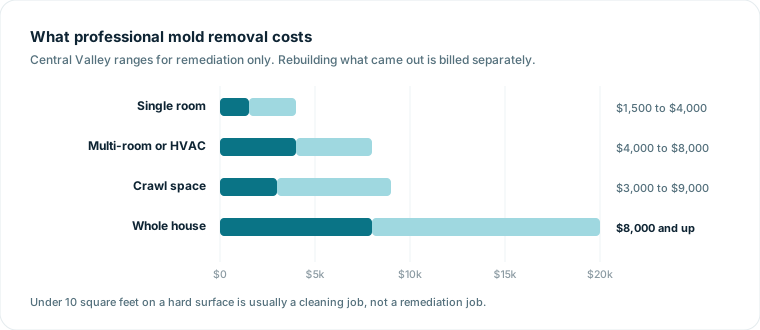
Here is the number most people come for: professional mold removal in a single contained room usually runs $1,500 to $4,000, and a job that has reached multiple rooms, the HVAC system, or a crawl space runs higher. Below roughly ten square feet on a hard surface, you are looking at a cleaning job you can do yourself, not a remediation job.
What follows is where those numbers come from, what a real remediation involves, and how to tell which situation you are actually in.
Is it actually black mold?
Probably not, in the specific sense people mean. “Black mold” usually refers to Stachybotrys chartarum, but plenty of common household molds are dark, and you cannot identify a species by looking at it. Cladosporium is extremely common and nearly black. So is the mildew on bathroom grout.
Here is the part that saves people money: it mostly does not matter. The remediation method is the same regardless of species, because the response is driven by how much material is affected and whether it is porous, not by what the mold is called. Testing before removal is rarely necessary and often a way to add a few hundred dollars to a job without changing a thing about it.
Testing is worth paying for in three situations: a dispute with an insurer or a landlord, a sale or purchase where somebody needs documentation, or a health complaint where a doctor specifically asked for it.
What drives the cost
Four things, in roughly this order of importance:
- Square footage affected. The single biggest driver, and it means affected material, not the size of the visible patch. Mold behind drywall is usually several times larger than what shows.
- Whether the material is porous. Tile and sealed concrete get cleaned. Drywall, insulation, carpet pad, and particleboard get removed and replaced, which adds both demolition and rebuild cost.
- Containment complexity. A single bathroom is easy to seal off. A job spanning an open floor plan, or one that reached the ductwork, needs far more containment and more air scrubbing.
- Access. Crawl spaces and attics cost more per square foot than a living room, because every task takes longer in a space where nobody can stand upright.
The rebuild is separate. The ranges above cover remediation only. Hanging new drywall, texturing, painting, and replacing flooring is a second line item, which is the same split described in the guide to mitigation versus restoration.
What a real remediation looks like
If someone quotes you a mold job and the plan is to spray the wall and wipe it down, that is not remediation. The thing that separates the two is containment.
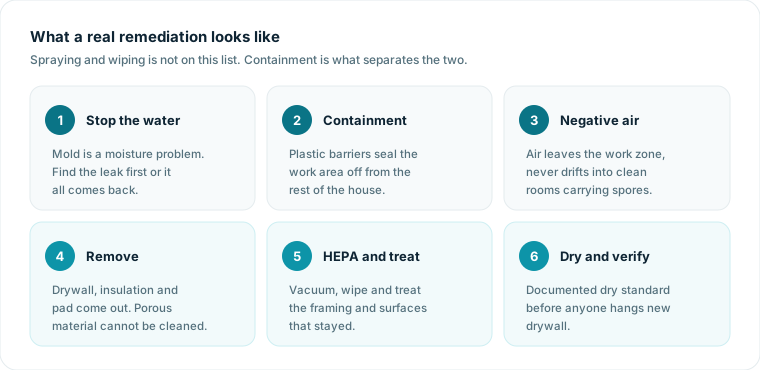
The step people underestimate is the first one. Mold is a moisture problem wearing a mold costume. If the leak, the condensation, or the crawl space humidity is still there when the crew leaves, the mold comes back in the same spot, and you pay twice. Any scope that does not name the moisture source is incomplete.
Negative air is the step that protects the rest of your house. Removing mold stirs up spores, and without machines holding the work area at lower pressure than the rooms around it, demolition spreads the problem into clean space.
When you can handle it yourself
Honestly: a small patch on a hard, non-porous surface is a reasonable Saturday job. Tile, glass, sealed countertops, the grout line in a shower. Clean it, dry the area properly, and fix whatever is keeping it wet.
Call a mold remediation crew when any of these are true:
- The affected area is larger than about ten square feet
- It is on or behind porous material: drywall, insulation, pad, or bare wood
- The water source was sewage or outside flooding, which is a category 3 loss from the start
- It is in or near the HVAC system, which can distribute spores everywhere
- Someone in the house is immune-compromised, asthmatic, pregnant, or elderly
- You have cleaned the same spot before and it came back
Bleach deserves its own warning. On porous material it is mostly water, so it soaks the substrate while lifting the surface stain. The wall looks fixed and is now wetter than it was. Use it on hard surfaces or not at all.
Does homeowners insurance cover mold removal?
Sometimes, and the test is almost always whether the underlying water loss was sudden and covered. Mold that followed a burst pipe is often covered. Mold that grew from a slow drip running for eight months usually reads as deferred maintenance and gets denied.
Two California specifics worth checking on your own declarations page before you need them. Many policies carry a mold sublimit, often $5,000 to $10,000, that applies no matter how the mold started. And mold from outside floodwater is not a homeowners claim at all, because flood is excluded and needs separate coverage.
The deciding factor in most disputes is documentation from day one, which is why the drying logs and photos from the original water loss matter so much. There is more on this in the guide to what homeowners insurance covers in California, and dispatch can help with claim paperwork.
Why Valley houses get mold without a leak
Plenty of local mold jobs have no dramatic water event behind them at all. Stockton and Lathrop sit over high water tables, so crawl spaces collect ground moisture year round. Tract homes across Tracy and Manteca share the same age of plumbing, so slab leaks and supply line failures arrive in clusters. Closed-up houses through a Valley August are warm and still, which is exactly what accelerates growth.
If your house smells musty and you cannot find a leak, check the crawl space before you check the walls. That is where it usually is.
Quick answers
How long does mold removal take? A single contained room is typically two to five days including drying. Larger jobs and crawl spaces run longer.
Do I need to move out? Usually not for a contained single-room job. For HVAC involvement, large areas, or a medically vulnerable household, crews often recommend staying elsewhere during the work.
Can mold come back after remediation? Only if the moisture source is still active. That is the whole reason step one exists.
How fast does mold start? Roughly 48 hours on wet material, faster in Valley heat. The mold growth timeline covers the hour by hour version.
The short version
Mold pricing tracks how much material has to come out, and how much has to come out tracks how long the moisture sat. A small patch is a cleaning job. Anything behind drywall is a containment job, and the only permanent fix starts with finding the water.
If something in your house smells musty or you have found growth you cannot explain, dispatch answers 24/7 across San Joaquin and Stanislaus Counties.